

5 ways a consumer insights consult transforms your shopper journey and boosts sales
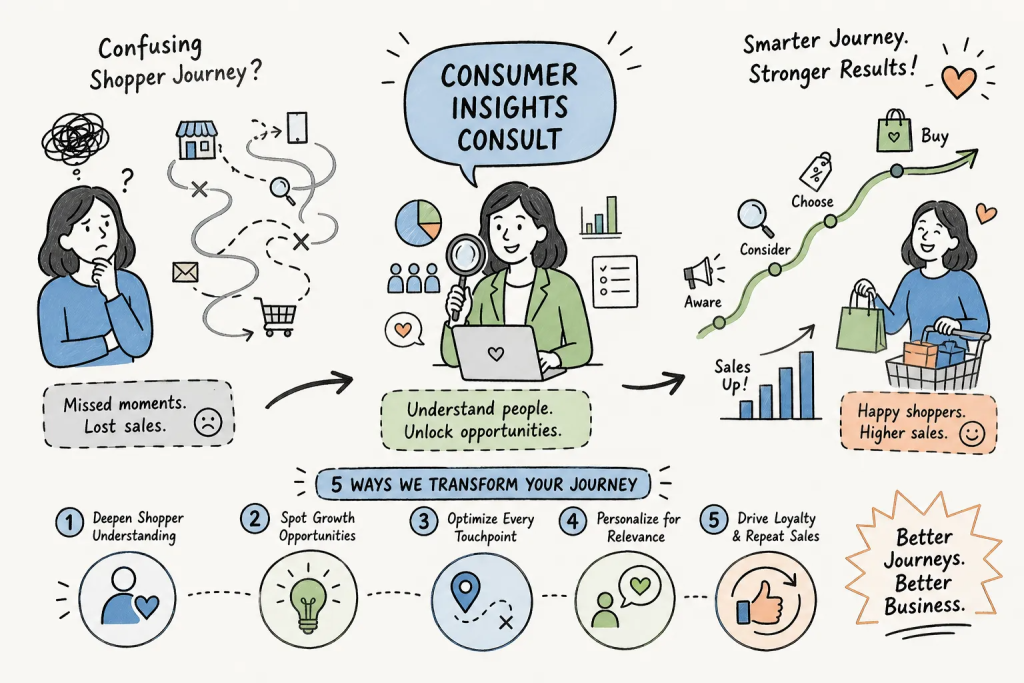
A consumer insights consult reveals the truth about your shopper, beyond sales data and gut instinct. Most brands think they understand who they're selling to. They've got last year's surveys, a tidy sales dashboard, and a confident internal view. Then they commission a proper external engagement and discover the story they were telling themselves was only half true.
A consumer insights consult is a structured engagement where an external specialist gathers, analyses, and translates real consumer evidence into commercial decisions. That distinction matters. It's not ad hoc market research tacked onto an existing project. It's a strategic intervention designed to support a specific business decision, whether that's a relaunch, a repositioning, or diagnosing why conversion has stalled.
Working with brands across FMCG, retail, and hospitality, the team at Liquid Insights consistently sees the same pattern: brands that act on evidence tend to outperform those that rely mainly on assumption. This guide covers what a consult actually delivers, when to hire externally, how to brief and select a partner, and the five specific ways it transforms how your shopper journey performs.
What a consumer insights consult actually covers
A proper engagement isn't just research. It's a commercial process with defined deliverables that connect directly to a business decision. Best-practice consults include strategic recommendations tied to specific decisions; purely descriptive outputs need further synthesis before they become decision-ready.
The four core deliverables most engagements include
Consumer research is the foundation. This means qualitative and quantitative methods combined: depth interviews, focus groups, surveys, and behavioural analytics. The aim is to surface real purchase drivers, not assumed ones. What consumers say and what they actually do are frequently different, and a robust engagement accounts for both.
Demand-space mapping goes further. It identifies the occasions, moods, and need-states that drive category entry. This is the deliverable that surfaces growth opportunities standard brand tracking misses entirely, because it maps demand by context rather than by product or demographic alone.
Category strategy translates that evidence into a clear picture of how your brand competes and wins within its product category. Not based on internal assumptions or what a competitor did last quarter. Based on what shoppers actually believe and want.
Shopper journey analysis ties it together. It maps every decision point from awareness to purchase and identifies where shoppers drop out, in-store, online, or both. The output is a set of actionable friction points with a commercial priority attached to each one.
How long an engagement typically takes and what you receive
A rapid diagnostic runs one to three weeks. A focused qualitative or quantitative study typically takes four to eight weeks. Mixed-method or segmentation programmes sit in the six to twelve week range. Final outputs should include an executive presentation, consumer personas or segmentation, a journey map with friction points, and strategic recommendations with prioritised actions. Every deliverable should connect to a commercial decision; purely descriptive outputs haven't gone far enough.
The 5 ways a consumer insights consult transforms your shopper journey
1. Consumer research replaces assumption with evidence
Brands regularly misidentify their shopper's core motivation. A brand repositions around convenience, invests in pack redesign and media spend, then wonders why the needle hasn't moved. Research reveals the actual trigger was social approval, not convenience at all. The category strategy and messaging should have shifted accordingly, but nobody commissioned the work to find out.
A proper consult uses depth interviews, focus groups, and behavioural analytics to surface the real purchase driver. Campaigns aligned to real consumer motivations often outperform those built on internal consensus, multiple client case studies and sector benchmarks report measurable improvements. It's a pattern that repeats across FMCG, retail, and hospitality when the work is done properly.
2. Demand-space mapping reveals where growth is hiding
Most brands measure market share. Demand-space mapping measures the occasions, moods, and needs that drive category entry. These are the spaces where a brand can grow without cannibalising its existing volume, and they're invisible to standard tracking.
In practice, consumers are mapped against need-states, and the brand's current and potential fit within each space is quantified. The output is a prioritised growth agenda: not just a map of where demand exists, but a ranked view of where your brand has permission to play and what it would take to win. This is where a specialist customer insights consulting partner earns its fee.
3. Category strategy gives your brand a defensible position
Without a category strategy grounded in real consumer data, positioning decisions are driven by competitor reaction or internal politics. Neither produces a durable advantage.
A consult delivers a clear picture of how shoppers perceive the category, where white space exists, and which positioning your brand can credibly own. At Liquid Insights, that means cross-referencing purchase panel data with qualitative insight to identify category dynamics before recommending a strategy, a firm-specific approach that has consistently surfaced positions built on something real, not something that sounded good in a workshop.
4. How a consumer insights consultant diagnoses conversion issues
This is where abstract insight becomes a direct sales intervention. A shopper journey analysis maps every decision point from awareness to purchase and identifies where shoppers drop out. In-store, that might mean poor shelf placement, confusing promotions, or product claims that don't land at point of purchase. Online, it might mean unclear product descriptions, friction in the checkout path, or weak social proof at the evaluation stage.
In some cases, brands acting on shopper journey findings have seen measurable lifts in conversion and repeat purchase within two quarters. The friction points are rarely mysterious once you look for them properly. They're just not visible from inside the building.
5. Evidence-based positioning builds brand equity that lasts
Positioning built on real consumer language and real shopper need-states is harder for competitors to replicate than positioning built on creative instinct. A consumer insight specialist ensures the brand's narrative connects to something genuinely motivating, not just something that resonated in a boardroom.
This is the compounding benefit of a proper consult: the insight doesn't expire after the project ends. It informs messaging, new product development, trade negotiations, and media planning. Every subsequent decision is made against a stronger evidence base than the one before it.
External expertise versus building in-house: how to decide
In-house teams are well suited to continuous tracking, operational reporting, and ongoing data analysis. They know the internal stakeholders, they understand the existing data assets, and they're fast when the question is "what happened?" The limitation surfaces when the question becomes "what should we do next, and why?"
An external market research consultant or consumer research agency brings methodological breadth, objectivity, and cross-sector pattern recognition that in-house teams rarely accumulate on their own. The critical triggers for commissioning externally are clear: entering a new category, repositioning a brand, diagnosing a sales decline, or designing a new shopper experience. External specialists are not constrained by internal assumptions, and that independence is often what surfaces the insight that changes a business decision.
The most effective model is a hybrid. A strong in-house function briefs and embeds insights; an external partner like Liquid Insights provides the specialist methodology and commercial challenge that internal teams can't easily provide for themselves.
How to brief and select a consumer insights consultancy
A weak brief produces weak research. Six elements matter: the business question (not the research question), existing evidence you already hold, a clear audience definition, success criteria, a realistic budget range, and a timeline tied to a specific decision milestone. Being specific about budget speeds up scoping and prevents wasted time on both sides. Being specific about the decision the work needs to support is even more important.
When you're in a credentials or chemistry meeting, ask for a specific case study where insight directly changed a commercial outcome: methodology, result, named sector. Not a vague claim about helping a major FMCG brand grow. Ask how they triangulate findings, do they use mixed methods, or rely on a single data source? Ask who will actually work on the project, because senior credentials in the pitch deck don't always mean senior delivery. And ask what happens after the report, because insight that doesn't get embedded into a decision is just a presentation.
What to expect on pricing, timelines, and next steps
UK project fees typically run from £5,000 to £15,000 for a focused study, £15,000 to £40,000 for a standard qualitative or quantitative programme, and £40,000 to £100,000 or more for multi-method or multi-market work. These figures reflect market ballparks and exclude costs such as sample, participant incentives, travel, and VAT. Day rates for a senior independent consultant sit between £800 and £1,200; boutique leads or specialist directors typically charge £1,200 to £2,000 or more. Retainers range from £3,000 to £8,000 per month for fractional support, and £8,000 to £20,000 or more per month for a senior ongoing partnership. Project fees suit defined deliverables; retainers suit recurring demand and priority access.
A typical Liquid Insights engagement begins with a brief focused on a specific commercial question, moves through a qualitative discovery phase to surface real consumer motivations, and then validates findings through quantitative demand-space mapping. The output is a set of recommendations tied directly to a category strategy or shopper journey intervention, with a prioritised action plan the brand can implement within a defined budget and timeline. That's the difference between insight as a report and insight as a commercial tool.
If your brand is repositioning, entering a new category, or watching conversion stall without explanation, this is the moment to commission external expertise. The data you already hold tells you what is happening. A well-scoped consumer insights consult tells you why, and what to do about it. If that's the conversation your business needs, get in touch and let's talk through your brief.